The Biology of Belief: Why You Can't "Assume the State" in a Dysregulated Body
Jan 13, 2026Want to go deeper?🎙️ Listen to the Make Your Own World Podcast — streaming now on YouTube, Spotify, & Apple.
Understanding the Biology of Belief
How the "Courage to Burn" Requires a Nervous System That Feels Safe
You've read Neville Goddard. You understand—intellectually—that to change your life, you must "assume the state of the wish fulfilled." You know you're supposed to feel it real, to dwell in the end, to occupy the consciousness of your desired reality until it hardens into fact.
And yet.
You close your eyes, you try to imagine yourself as the person who already has what you want—and your heart starts racing. Your palms get sweaty. Your mind floods with objections: This isn't true. You're lying to yourself. Who do you think you are?
You push harder. You repeat affirmations. You try to force yourself into the feeling. But your body doesn't believe you. It feels like you're fighting against something deep and immovable—something that refuses to let you step into the new identity you're trying to claim.
Here's what no one tells you about manifestation: You cannot think your way out of a physiological state.
If your nervous system is in survival mode—if your body is running the ancient programming of fight, flight, or freeze—it doesn't matter how many times you repeat "I am abundant" or "I am worthy." Your biology is scanning for threats, not dwelling in the wish fulfilled. And until that changes, the gap between where you are and who you want to become will feel impossibly wide.
The Moth, the Flame, and the Courage to Burn
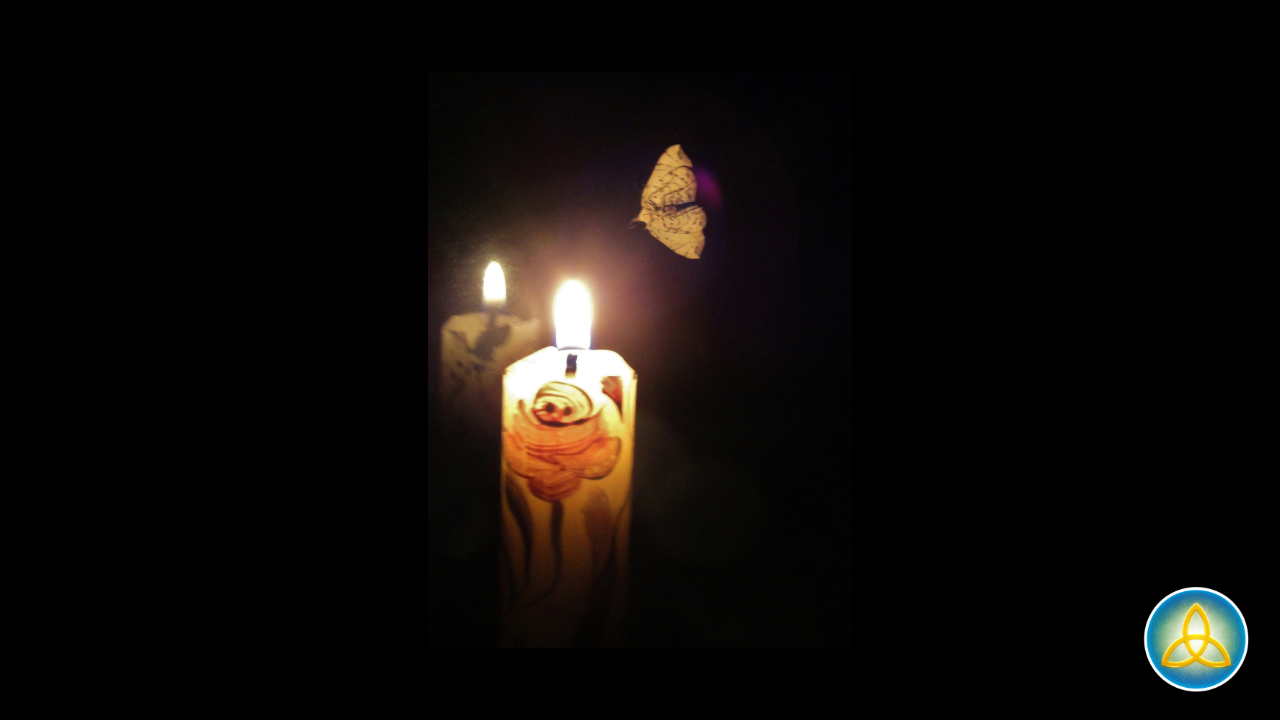
In Sufi poetry, there's an image that has stayed with me for years: the moth and the flame. The moth circles the fire, drawn to its light, hovering at the edge—wanting, yearning, but never quite surrendering. It's only when the moth finally stops circling and flies directly into the flame that transformation happens. The moth doesn't just get close to the fire. It becomes the fire.
This is what Neville meant by "dying to the old man." It's what spiritual traditions across time have pointed toward: the death of the limited self, the burning away of who you thought you were, so that something truer can emerge. The transformation isn't intellectual. It's total. It requires what I call the courage to burn.
But here's the clinical reality that most spiritual teachers don't address: To your nervous system, that flame looks like death.
Not metaphorical death. Actual death. Your body can't tell the difference between the dissolution of an old identity and a genuine threat to your survival. To the ancient, protective parts of your brain, change—even positive change, even change you desperately want—registers as danger. And when danger registers, your nervous system does exactly what it's designed to do: it pulls you back from the flame.
This is why you self-sabotage. This is why you circle and circle the life you want but never quite land in it. It's not because you lack willpower or faith. It's because your body is trying to protect you from a fire it doesn't understand.
Why High-Achievers Get Stuck Here
If you're someone who has achieved outward success—the career, the credentials, the external markers of a life well-lived—this tension may feel especially confusing. You're not used to feeling stuck. You've always been able to think your way through problems, to strategize and execute your way to results.
But here's what I've observed in over twenty years of clinical work: the same analytical mind that built your success can become the very thing that keeps you trapped.
When you try to "assume the state" of a new identity, your analytical brain kicks into overdrive. It wants evidence. It wants proof. It wants to know how this is going to work before it's willing to let you feel that it already has. Meanwhile, your vagus nerve—the master regulator of your stress response—is sending "danger" signals to your brain. The result is an internal tug-of-war: your mind trying to logic its way into transformation while your body screams that transformation isn't safe.
There's another layer to this. Your nervous system is, in a very real sense, addicted to your current identity. Not because that identity makes you happy—often it doesn't—but because it's familiar. And to the survival brain, familiar equals safe. The misery you know feels less threatening than the freedom you don't.
So you stay. You circle the flame. You tell yourself you'll make the leap "when the time is right" or "when things settle down" or "when I have more clarity." But the clarity never comes—because clarity isn't the issue. The issue is that your nervous system hasn't been given permission to let go.
The Path Through: Regulation Before Revelation
If you've been trying to manifest or transform your life and feel like your body is fighting you every step of the way, I want you to hear this clearly: You don't need more willpower. You need a different approach.
The work I do with clients bridges two worlds that are rarely brought together: the clinical science of nervous system regulation and the spiritual practice of identity transformation. Because here's what I've learned—you can't skip the body on the way to the soul. The two are inseparable.
The first step isn't assuming the state. It's regulation—learning to bring your nervous system into a state of safety so that transformation becomes biologically possible. This is where mindfulness practices, somatic awareness, and breath work become essential. Not as spiritual bypasses, but as genuine preparation for the deeper work. You have to teach your body that it's safe to change before you ask it to change.
The second step is presence—learning to sit with the heat of the flame without flying away. This is the hardest part for high-achievers, because presence means stopping. It means not solving, not fixing, not strategizing. It means letting yourself feel the discomfort of the in-between space where the old identity is dying and the new one hasn't yet fully formed. Most people bolt at this stage. The ones who transform are the ones who stay.
The third step is immersion—what Neville called "entering the state." But here's the difference: when your body is regulated and present, the immersion happens naturally. You're not forcing yourself to feel something your nervous system is rejecting. You're allowing yourself to sink into a felt sense of your new reality because your body finally feels safe enough to go there. This is the moth entering the flame—not through willpower, but through surrender.
Bridging the Gap
The spiritual teachers will tell you to assume the state. The neuroscientists will tell you to regulate your nervous system. What I've found, after decades of studying both, is that neither approach works fully without the other.
You need the vision—the clear knowing of who you're becoming and the life you're stepping into. And you need the body—a nervous system that feels safe enough to let the old identity die so the new one can live.
If you've been circling the flame, wondering why you can't seem to make the leap, I want you to know: there's nothing wrong with you. You're not broken, and you don't lack faith. You may simply need a guide who understands both the biology of belief and the courage it takes to burn.
—
Ready to bridge the gap between your nervous system and your vision? I work one-on-one with high-achieving professionals who are ready for deeper integration—combining clinical mindfulness with spiritual identity work. If you're curious about what that might look like for you, reach out for a consultation.
And if you want to explore the moth and flame metaphor more deeply, watch my latest video: "The Moth & The Flame: The Courage to Fully Immerse" on the Journey Mindfulness YouTube channel.